Matrix Operations
June 22, 2010
Our Standard Prelude provides a matrix datatype with create, lookup and setting operations. In today’s exercise we extend the matrix datatype with some mathematical operations: sum two matrices, multiply a matrix by a scalar, multiply two matrices, and transpose a matrix.
- Addition of two matrices is done by adding elements in corresponding positions, assuming identical dimensions. For example:
- Multiplying a scalar times a matrix is done by multiplying the scalar times each element in turn. For example:
- The product of an m×n matrix A and an n×p matrix B is the m×p matrix C whose entries are defined by
. For example:
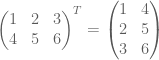
- The transpose of a matrix interchanges the rows and columns of a matrix. For example:



Your task is to write functions that perform the four matrix operations described above. When you are finished, you are welcome to read or run a suggested solution, or to post your own solution or discuss the exercise in the comments below.
 Programming Praxis
[…] Praxis – Matrix Operations By Remco Niemeijer In today’s Programming Praxis exercise our task is to implement four common matrix operations. The provided […]
My Haskell solution (see http://bonsaicode.wordpress.com/2010/06/22/programming-praxis-matrix-operations/ for a version with comments):
Here’s my Java solution.
@Remco,
Your Haskell solution is gorgeous (its simplicity astounds me). I’ll hopefully be able to churn out solutions like that in Haskell soon! =)
@Elvis Montero:
Thanks. Best of luck with learning Haskell. I can highly recommend it :)
@Remco,
Your post has inspired me to learn Haskell!
;;; A scheme solution. Nothing like the beauty of the haskell one though ;-)
;; Q1
(define (add-matrix m1 m2)
(cond ((or (null? m1) (null? m2)) ‘())
(else (cons (sum-list (car m1) (car m2))
(add-matrix (cdr m1) (cdr m2))))))
;; Q1 helper
(define (sum-list l1 l2)
(cond ((or (null? l1) (null? l2)) ‘())
(else (cons (+ (car l1) (car l2))
(sum-list (cdr l1) (cdr l2))))))
;; Q2
(define (scale s m)
(letrec ((scale* (lambda (m)
(cond ((null? m) ‘())
(else (cons (mul-list s (car m))
(scale* (cdr m))))))))
(scale* m)))
;; Q2 helper
(define (mul-list s l)
(letrec ((mul-list* (lambda (l)
(cond ((null? l) ‘())
(else (cons (* s (car l))
(mul-list* (cdr l))))))))
(mul-list* l)))
;; Q3
(define (X A B)
(cond ((null? A) ‘())
(else (cons (psum (car A) B)
(X (cdr A) B)))))
;; Q3 helper – genereate list of cross-sums
(define (psum l m)
(letrec ((psum* (lambda ™
(cond ((null? tm) ‘())
(else (cons (xs l (car tm))
(psum* (cdr tm))))))))
(psum* (transpose m))))
;; Q3 helper – multiply each element and sum result
(define (xs l1 l2)
(cond ((or (null? l1) (null? l2)) 0)
(else (+ (* (car l1) (car l2)) (xs (cdr l1) (cdr l2))))))
;; Q4
(define (transpose m)
(cond ((null? (car m)) ‘())
(else (cons (list-of-heads m)
(transpose (list-of-tails m))))))
;; Q4 helper
(define (list-of-heads m)
(cond ((null? m) ‘())
(else (cons (car (car m))
(list-of-heads (cdr m))))))
;; Q4 helper
(define (list-of-tails m)
(cond ((null? m) ‘())
(else (cons (cdr (car m))
(list-of-tails (cdr m))))))
bah.. indents lost :-(
one with proper indents on pocoo….
http://paste.pocoo.org/show/nZhGWlzvWmDhV9pRV5im/
Geir S: list-of-heads is just (map car m)
Interestingly I realized after writing it that I duplicated the Haskell version above in Scheme, though I put scalar multiplication into matrix multiplication. I have such a hard time reading Haskell that I couldn’t notice it before! No error checking. A matrix is a list of lists.
(define transpose (λ(l) (if (empty? (first l)) empty (cons (map first l) (transpose (map rest l)))))) (define add (λ(one two) (map (λ(x y) (map + x y)) one two))) (define times (λ(one two) (let ((sum (λ(list) (foldl + 0 list)))) (if (number? one) (map (λ(x) (map (λ(y) (* one y)) x)) two) (let ((two (transpose two))) (map (λ(x) (map (λ(y) (sum (map * x y))) two)) one))))))My Haskell solution:
-- Matrix.hs
--
-- Defines a Matrix data type and operations upon Matrices

data Matrix a = Matrix [[a]]
     deriving (Show, Eq)

-- Add two matrices together
--
--   > addMatrices (Matrix [[1,2,3], [4,5,6]]) (Matrix [[2,3,4], [3,4,5]])
--   Matrix [[3,5,7], [7,9,11]]
--
addMatrices :: (Num a) => Matrix a -> Matrix a -> Matrix a
addMatrices (Matrix m1) (Matrix m2) = Matrix $ zipWith (zipWith (+)) m1 m2

-- Multiply a matrix by a scalar
--
--   > multScalar 2 (Matrix [[1,2,3], [4,5,6]])
--   Matrix [[2,4,6], [8,10,12]]
--
multScalar :: (Num a) => a -> Matrix a -> Matrix a
multScalar x (Matrix m) = Matrix $ map (map (x*)) m

-- Multiply two matrices together
--
--   > multMatrices (Matrix [[1,2,3], [4,5,6]]) (Matrix [[1,2,3,4], [2,3,4,5], [3,4,5,6]])
--   Matrix [[14,20,26,32],[32,47,62,77]]
--
multMatrices :: (Num a) => Matrix a -> Matrix a -> Matrix a
multMatrices (Matrix m1) (Matrix m2) = Matrix $ [ map (multRow r) m2t | r <- m1 ]
    where (Matrix m2t) = transposeMatrix (Matrix m2)
          multRow r1 r2 = sum $ zipWith (*) r1 r2

-- Transpose a matrix
--
--   > transposeMatrix (Matrix [[1,2,3], [4,5,6]])
--   Matrix [[1,4], [2,6], [3,6]]
--
transposeMatrix :: Matrix a -> Matrix a
transposeMatrix (Matrix m) = Matrix (zipList m)

-- Zip together a list of lists. The result is truncated to the length of the
-- shortest list. This is like the builtin zip function, except it can zip
-- together an arbitrary number of lists.
zipList :: [[a]] -> [[a]]
zipList lists
    -- Base cases: there are no lists, or any sub-list is empty
    | length lists == 0          = []
    | any ((==0) . length) lists = []
    -- Take the head from each sub-list and recurse with the tails
    | otherwise                  = map head lists : zipList (map tail lists)
Not nearly as sexy as @Remco’s, partly because I used a Matrix data type that complicated things somewhat unnecessarily. I wrote zipList from scratch before remembering there was a ‘transpose’ function in Data.List, but overall this was a good learning experience. I remember back when I was into C++, and I wrote some matrix classes–the header declarations alone were longer than this :-)
My Python solution with convenient operators overloading, though not very effective:
Scheme solution: