Chutes And Ladders
March 4, 2011
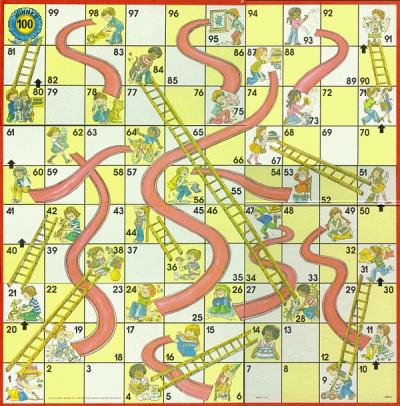 The children’s game Chutes and Ladders, pictured at right, is a chase game in which one or more players, moving alternately, move their tokens along the numbered spaces of a board according to the roll of a die; the tokens are initially off-the-board at what is effectively space zero. Tokens that land on the bottom end of a ladder are promoted to the space at the top end of the ladder, and tokens that land on the top end of a chute are demoted to the space at the bottom end of the chute. Space 100 must be reached by exact roll of the die; if the roll of the die would take the token past space 100, the token remains where it is and play passes to the next player. The winner of the game is the first token to reach space 100.
There are several interesting questions that can be asked about the game. First, what is the minimum number of rolls required to reach space 100. Second, for a single player, what is the average number of rolls required to reach space 100. And third, for k players, what is the average number of rolls until one of the players reaches space 100 and wins the game. S. C. Althoen, L. King and K. Schilling studied these and other questions in their paper “How Long Is a Game of Snakes and Ladders?” The Mathematical Gazette, Volume 77, Number 478, March 1993, pages 71-76.
Your task is to write programs that will answer those questions. When you are finished, you are welcome to read or run a suggested solution, or to post your own solution or discuss the exercise in the comments below.
 Programming Praxis
My Haskell solution (see http://bonsaicode.wordpress.com/2011/03/04/programming-praxis-chutes-and-ladders/ for a version with comments):
import Control.Monad import System.Random promote :: Num a => a -> a promote n = maybe n id $ lookup n [(16,6), (47,26), (49,11), (56,53), (62,19), (64,60), (87,24), (93,73), (95,75), (98,78), (1,38), (4,14), (9,31), (21,42), (28,84), (36,44), (51,67), (71,91), (80,100)] game :: IO [Int] game = fmap (tail . turn 0 . randomRs (1,6)) newStdGen where turn 100 _ = [100] turn n ~(d:ds) = n : turn (if n+d > 100 then n else promote $ n+d) ds stats :: Int -> Int -> IO (Int, Int, Float) stats k n = fmap (\rs -> (minimum rs, maximum rs, average rs)) . replicateM n . fmap minimum . replicateM k $ fmap length game where average xs = fromIntegral (sum xs) / fromIntegral n main :: IO () main = do print =<< stats 1 100000 print =<< stats 2 100000 print =<< stats 3 100000 print =<< stats 4 100000 print =<< stats 5 100000[…] today’s Programming Praxis exercise, our goal is to simulate the board game Chutes and Ladders. Let’s […]
Not terribly fast, though it gets the job done. To speed this up, I tried
1. Numpy arrays (which doesn’t get much of an improvement),
2. PyPy (which sped things up a lot), and
3. Cython to compile the code.
None of these three options come standard with the typical Python installation,
unfortunately. As a further exercise for myself, I went about compiling via
Cython, without changing the original code beyond all recognition; details
available on codepad.
#!/usr/bin/env python from random import randrange def single_game(chutes, ladders): pos, path = 0, [] while pos < 100: pos += randrange(1, 7) if pos in chutes: pos = chutes[pos] elif pos in ladders: pos = ladders[pos] path.append(pos) if path[-1] > 100: path[-1] = 100 return path def mult_games(n, chutes, ladders): return [len(single_game(chutes, ladders)) for _ in xrange(n)] def compete(k, n, chutes, ladders): return [min(mult_games(k, chutes, ladders)) for _ in xrange(n)] def mean(xs): return sum(xs) / float(len(xs)) def stats(k, n, chutes, ladders): games = compete(k, n, chutes, ladders) return min(games), max(games), mean(games) if __name__ == "__main__": chutes = {16: 6, 47: 26, 49: 11, 56: 53, 62: 19, 64: 60, 87: 24, 93: 73, 95: 75, 98: 78} ladders = {1: 38, 4: 14, 9: 31, 21: 42, 28: 84, 36: 44, 51: 67, 71: 91, 80: 100} for k in xrange(1, 7): print stats(k, 100000, chutes, ladders)I’ve got a Haskell solution similar to Remco Niemeijer’s one, so I decided not to repeat it here once more.
Instead, I solved the first question regarding the minimal number of rolls in a “theoretical” way, without simulating the game itself. I converted the game board into a directed graph — each node has 6 outgoing edges, corresponding to 6 possible rolls (or less, if it’s near 100) and then used breadth-first search to find out the shortest path length from start to finish. It turned out to be 7.
import Data.Graph.Inductive hiding (nodes, edges, run) import Data.Graph.Inductive.Query.BFS (esp, lesp) start = 0 finish = 100 step = 6 transitions = [ (1, 38), (4, 14), (9, 31), (16, 6), (21, 42), (28, 84) , (36, 44), (47, 26), (49, 11), (51, 67), (56, 53), (62, 19) , (64, 60), (71, 91), (80, 100), (87, 24), (93, 73), (95, 75) , (98, 78) ] nodes :: [(Int, ())] nodes = [(n, ()) | n <- [start .. finish]] edges :: [(Int, Int, ())] edges = concatMap (edges' . fst) nodes where edges' x = [ edge x n (lookup n transitions) | k <- [1 .. step], let n = x + k, n <= finish ] edge x n (Just trans) = (x, trans, ()) edge x n Nothing = (x, n, ()) gameGraph :: Gr () () gameGraph = mkGraph nodes edges shortestGame :: Int shortestGame = length (esp start finish gameGraph) - 1Here’s my python solution. Uses the dijkstra function from a previous exercise to find the minimum path.
from dijkstra import * from random import randrange chutes = {98:78, 95:75, 93:73, 87:24, 64:60, 62:19, 56:53, 49:11, 47:26, 16: 6 } ladders = { 1:38, 4:14, 9:31, 21:42, 28:84, 36:44, 51:67, 71:91, 80:100 } special = dict(chutes.viewitems() | ladders.viewitems()) # transision table: next_sq[current square][dice roll - 1] -> next square # includes effects of slides and ladders, so next_sq[0][1] is 38 next_sq = [[special.get(r,min(r, 100)) for r in range(n+1,n+7)] for n in range(101)] # create graph from the transition table graph = {n:{t:1 for t in next_sq[n]} for n in range(101)} mst = dijkstra(graph,0,100) mst[100] # returns (7, 74), min of 7 turns, previous sequare is 74 def play(nplayers=1): sq = [0]*nplayers nturns = 0 while True: nturns += 1 for player in range(nplayers): sq[player] = next_sq[sq[player]][randrange(6)] if sq[player] == 100: return nturns, player for nplayers in range (1,6): turns = [play(nplayers)[0] for _ in range(10000)] print float(sum(turns))/len(turns), min(turns)These implementations which walk a tree take a long time to run – the first haskell program takes on the order of 30 seconds to print the first statistics on my system. A faster way is to create a transition matrix and repeatedly multiply with a state vector to compute the probability of any particular state after N turns. Experimentally, after 350 iterations, this accounts for 99.9999% of all games and produces an answer of avg turns = 39.2 in under a second of CPU time.
My Try in Rexx, Using the Dijkstra-Algorithm from https://programmingpraxis.com/2011/01/04/dijkstras-algorithm/ to find the optimal strategy
MAX = 99999 chutes = '16-6 47-26 49-11 56-53 64-60 62-19 87-24 93-73 95-75 98-78' ladders = '1-38 4-14 10-31 28-84 21-42 36-44 51-67 71-91 80-100' ch. = '' ld. = '' erg. = '' cnt = 0 orte = '' strecken = '' call init_basic call zufall 100, 1 call zufall 100, 3 call zufall 100, 10 call zufall 100, 100 call ergebnis_zufall start = 1 ziel = 100 d. = MAX d.start = 0 p. = '' call init_shortest_path call optimal_path exit zufall: parse arg t, p ct_sum = 0 do games = 1 to t hundert = 0 player_pos. = 0 do while hundert == 0 /* ---------------------- */ /* p = Anzahl der Spieler */ /* ---------------------- */ do player = 1 to p wrk = 0 cp = player_pos.player if cp == 100 then do hundert = 1 leave end select /* -------------------------------- */ /* Akt. Pos = Beginn einer Leiter ? */ /* Neue Position = Ende der Leiter */ /* -------------------------------- */ when ch.cp > 0 then wrk = ch.cp /* -------------------------------- */ /* Akt. Pos = Oben an Rutsche ? */ /* Neue Position = Unten an Rutsche */ /* -------------------------------- */ when ld.cp > 0 then wrk = ld.cp otherwise do /* -------------------------------- */ /* Wuerfeln Zufallszahl zw. 1 und 5 */ /* -------------------------------- */ wrk = cp + random(1, 6) ct_sum = ct_sum + 1 /* --------------------------------------*/ /* wenn neue Pos. > 100, dann ignorieren */ if wrk > 100 then iterate player /* --------------------------------------*/ end end player_pos.player = wrk end end end cnt = cnt + 1 erg.cnt = p 'Personen mussten (/)', 'bei' t 'Versuchen durchschn.', ((ct_sum % p) % t) 'mal wuerfeln.' return init_basic: do while words(chutes) > 0 parse value chutes with first chutes parse value first with start'-'end ch.start = end end do while words(ladders) > 0 parse value ladders with first ladders parse value first with start'-'end ld.start = end end return init_shortest_path: do x = 1 to 100 orte = orte x end do x = 1 to 100 ks = '' if ch.x > '' then iterate if ld.x > '' then ks = ks x'-'ld.x'-'0 do y = x+1 to min(x+6,100) if strip(ch.y) == '' then ks = ks x'-'y'-'1 end strecken = strecken ks end return ergebnis_zufall: say cnt do i = 1 to cnt say erg.i end return optimal_path: q = orte do while words(q) > 0 u = n_nb(q) if u == '' then leave q = delword(q, wordpos(u,q), 1) call relax u,strecken end say reverse(translate(strip(ausgabe(ziel, '')),'<',' ')), '=' d.ziel 'Wuerfe' return n_nb: procedure expose d. MAX parse arg q min = MAX rw = '' do i = 1 to words(q) w = word(q, i) if d.w < min then do min = d.w rw = w end end return rw relax: procedure expose d. p. parse arg akt,kanten do while length(kanten) > 0 parse value kanten with kante kanten parse value kante with von'-'nach'-'entf select when akt == von then nb = nach otherwise iterate end neu = d.akt + entf if d.nb > neu then do d.nb = neu p.nb = akt end end return ausgabe: parse arg vorg, route if p.vorg == '' then return strip(reverse(route vorg)) return ausgabe(p.vorg,route vorg)[…] la serpiente posición. A la derecha? He utilizado la simulación para resolver este problema en mi blog. Mi solución es en el Esquema; también hay soluciones en Haskell y Python. Además de la […]
[…] usato la simulazione per risolvere questo problema sul mio blog. La mia soluzione è a Regime; ci sono anche soluzioni in Haskell e Python. Oltre alla simulazione […]