The Digits of Pi, Again
June 14, 2013
The ratio of the circumference to the diameter of a circle, known as π, is constant regardless of the size of the circle; that fact has been known to mathematicians for about five thousand years; much of the history of mathematics is intertwined in the history of πi, as approximations of the ratio have improved over time. Much of the history of this blog is also intertwined in the calculation of π; one of the original ten exercises used a bounded spigot algorithm of Jeremy Gibbons to calculate π, and later we used an unbounded spigot algorithm also due to Gibbons; we studied the ancient approximation of 355/113 calculated by Archimedes; we studied two different Monte Carlo simulations of π; and we even had the Brent-Salamin approximation contributed by a reader in a comment.
The development of computers allows us to compute the digits of π to an astonishing accuracy; the current record, unless somebody has bettered it recently, is ten trillion digits. That record was set by the Chudnovsky brothers, two Russian mathematicians living in New York, using an algorithm they developed in 1987. The algorithm is based on a definition of π developed by Ramanujan, and is beautifully described by the two brothers.
Your task is to compute many digits of π using the Chudnovsky algorithm. When you are finished, you are welcome to read or run a suggested solution, or to post your own solution or discuss the exercise in the comments below.
Longest Substring Of Two Unique Characters
June 11, 2013
Today’s exercise comes from our unending list of interview questions:
Find the longest run of consecutive characters in a string that contains only two unique characters; if there is a tie, return the rightmost. For instance, given input string
abcabcabcbcbc, the longest run of two characters is the 6-character run ofbcbcbcthat ends the string.
Your task is to write the requested program. When you are finished, you are welcome to read or run a suggested solution, or to post your own solution or discuss the exercise in the comments below.
Sets
June 7, 2013
Sets are ubiquitous in programming; we’ve used sets in several of our exercises. In most cases we made the sets from lists, which is good enough when the sets are small but quickly slows down when the sets get large. In today’s exercise we will write a generic library for sets.
The sets that we will consider are collections of items without duplicates. We will provide an adjoin function to add an item to a set if it is not already present and a delete function to remove an item from a set if it is present. A member function determines if a particular item is present in a set. The three set operations that are provided are intersection, union and difference; we will consider that the universe from which items are drawn is infinite, or at least too large to conveniently enumerate, so we will not provide a complement operation. For convenience, we will also provide functions to calculate the cardinality of a set and to create a list from the items present in the set.
Your task is to write a library for handling sets, based on the description given above. When you are finished, you are welcome to read or run a suggested solution, or to post your own solution or discuss the exercise in the comments below.
Egyptian Fractions
June 4, 2013
One topic that has always fascinated me is the mathematical sophistication of the ancients. The Pythagorean theorem is twenty-five hundred years old. Euclid’s Elements of 300BC remained in use as a geometry textbook for over two millenia, and is still in print today (you can buy the Dover edition for $1). Eratosthenes was sieving prime numbers two centuries before Christ.
Today’s topic is Egyptian fractions, which were mentioned in the Rhind Papyrus of 500BC as an “ancient method” and are thought to date to the time of the pyramids; they survived in use until the 17th or 18th century. Leonardo de Pisa’s famous book Liber Abaci of 1215AD, which introduced to European mathematicians the concept of zero, the Hindu-Arabic system of numeration, and the famous rabbit sequence (Leonardo’s nickname was Fibonacci).
An Egyptian fraction was written as a sum of unit fractions, meaning the numerator is always 1; further, no two denominators can be the same. As easy way to create an Egyptian fraction is to repeatedly take the largest unit fraction that will fit, subtract to find what remains, and repeat until the remainder is a unit fraction. For instance, 7 divided by 15 is less than 1/2 but more than 1/3, so the first unit fraction is 1/3 and the first remainder is 2/15. Then 2/15 is less than 1/7 but more than 1/8, so the second unit fraction is 1/8 and the second remainder is 1/120. That’s in unit form, so we are finished: 7 ÷ 15 = 1/3 + 1/8 + 1/120. There are other algorithms for finding Egyptian fractions, but there is no algorithm that guarantees a maximum number of terms or a minimum largest denominator; for instance, the greedy algorithm leads to 5 ÷ 121 = 1/25 + 1/757 + 1/763309 + 1/873960180913 + 1/1527612795642093418846225, but a simpler rendering of the same number is 1/33 + 1/121 + 1/363.
Your task is to write a program that calculates the ratio of two numbers as an Egyptian fraction. When you are finished, you are welcome to read or run a suggested solution, or to post your own solution or discuss the exercise in the comments below.
The Seven Bridges of Königsberg
May 31, 2013
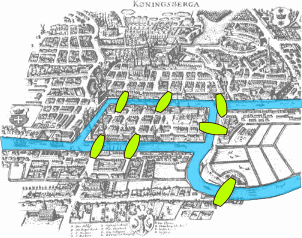 Our exercise today studies a famous problem solved by the great Swiss mathematician Leonhard Euler in 1735, which marked the beginning of what is now the “graph theory” branch of mathematics. Euler proved that it was impossible to cross all seven bridges once without retracing your path. He proved that a complete circuit, returning to the starting point, is possible only if all vertices connect to an even number of neighbors, and a complete path that doesn’t return to the starting point is possible if exactly two of the vertices have an odd number of neighbors, the rest being even, in which case the two odd-count vertices are the starting and ending points of the path.
The following algorithm to determine a eulerian path in a graph, if it exists, is ancient; I would be happy if anybody can provide a pointer to the source of the algorithm:
1) If a complete circuit is possible, choose any vertex at random as the current vertex. If a complete path but not a circuit is possible, choose either of the two odd-degree vertices at random. Otherwise, quit.
2a) If the current vertex has neighbors, add it to the stack, choose any of its neighbors as the new current vertex, and remove the edge between the two vertices.
2b) If the current vertex has no neighbors, add it to the path, remove the last vertex from the stack and make it the current vertex.
3) Repeat step 2 until the current vertex has no neighbors and the stack is empty.
4) Add the current vertex to the path and quit.
Your task is to write programs that determine if a graph is an eulerian circuit or eulerian path and, if it is, determine the path. When you are finished, you are welcome to read or run a suggested solution, or to post your own solution or discuss the exercise in the comments below.
Modular Multiplication Without Overflow
May 28, 2013
We discussed modular arithmetic in a previous exercise. In a comment on that exercise, Matthew asked what you can do when you have a fixed size integer datatype (say 64-bit unsigned integers) and a modulus that is close to the maximum. That’s a good question, which we will answer today. The answer is straight forward if the modulus is at least one bit less than the maximum, and rather trickier if it’s not. We’ll look at multiplication, but the other operations are all similar.
As long as the modulus is at least one bit less than the maximum, the solution is to split the numbers in low-bit and high-bit halves, then perform the arithmetic piecemeal, kind of like grade-school multiplication where you multiply by the one’s digit, then shift the sum and multiply by the ten’s digit, and so on, except that the “digits” are the size of the square root of the maximum number than can be represented in the integer datatype.
If m is within one bit of the maximum for the integer data type, things get messier; the basic answer is to split into three parts, compute the intermediate products, and recombine. But we won’t bother with that.
Your task is to write a function that performs modular multiplication without overflow. When you are finished, you are welcome to read or run a suggested solution, or to post your own solution or discuss the exercise in the comments below.
Coin Change, Part 3
May 24, 2013
Our exercise today is similar to the two previous exercises on the coin change problem, but doesn’t directly involve coins. But we’ll still call it a coin change problem because I can’t think of a better name.
As in the coin change problems, we are given a target to which a set of coins is intended to sum. But instead of a list of coins, we are given a number n and assume that we have one of each denomination of coin from 1 through n. Unlike the coin change problems, we have only one of each coin, not an infinite number of them.
The problem is to figure out all the ways to combine coins to reach the desired sum. For instance, if the sum s is 10 and n is 10, the ways to combine the coins are (10), (9 1), (8 2), (7 3), (7 2 1), (6 4), (6 3 1), (5 4 1), (5 3 2), and (4 3 2 1). Note that a set like (6 2 2) is not possible because only one 2-coin is available. As in the two previous exercises, we are interested in both a function to make a list of all the solutions and a separate function that simply counts them.
Your task is to write the two programs described above. When you are finished, you are welcome to read or run a suggested solution, or to post your own solution or discuss the exercise in the comments below.
Coin Change, Part 2
May 21, 2013
In the previous exercise we studied the classic coin change problem to find all the ways to make a given amount of change using a given set of coins. Sometimes the problem in a different way: find the minimum set of coins needed to make a given amount of change. As with the prior exercise, sometimes the task is to find just the count and sometimes the task is to find the actual set of coins.
Your task is to write the two programs described above. When you are finished, you are welcome to read or run a suggested solution, or to post your own solution or discuss the exercise in the comments below.
Coin Change, Part 1
May 17, 2013
It is a classic problem from computer science to determine the number of ways in which coins can be combined to form a particular target; as an example, there are 31 ways to form 40 cents from an unlimited supply of pennies (1 cent), nickels (5 cents), dimes (10 cents) and quarters (25 cents), ranging from the 3-coin set (5 10 25) to the 40-coin set consisting only of pennies.
The solution is usually stated in recursive form: if c is the first coin in the set of coins cs and n is the target, the solution is the number of ways to reach the target after removing c from cs plus the number of ways to reach n − c using all the coins in cs. The algorithm to make a list of the coins, instead of the count, is the same, but keeping track of the list of coins instead of the count.
Your task is to write two functions, one to determine the count and one to determine the list of coins. When you are finished, you are welcome to read or run a suggested solution, or to post your own solution or discuss the exercise in the comments below.
Optimal Alphabetical Order
May 14, 2013
Today’s exercise comes from the book Making the Alphabet Dance: Recreational Wordplay by Ross Eckler, but I found it at http://www.math.cmu.edu/~bkell/alpha-order/:
Assume we have a list of all the words in the English language. Under the normal ordering of the alphabet in English (A, B, C, …, Z), some number of these words have all their letters in alphabetical order (for example, DEEP, FLUX, and CHIMPS). However, if we change the ordering of the alphabet, we will change the number of words having their letters in “alphabetical” order. What arrangement of the letters of the alphabet maximizes this number?
Your task is to write a program to find such an arrangement. When you are finished, you are welcome to read or run a suggested solution, or to post your own solution or discuss the exercise in the comments below.
 Programming Praxis